P-BOARD control boards
P-BOARD covers the motion and input-output boards mounted inside the machine control cabinet. It matters when a machine needs stable axis control, clean signal handling and a sensible spare-board plan for workshop use.
What P-BOARD does inside the cabinet
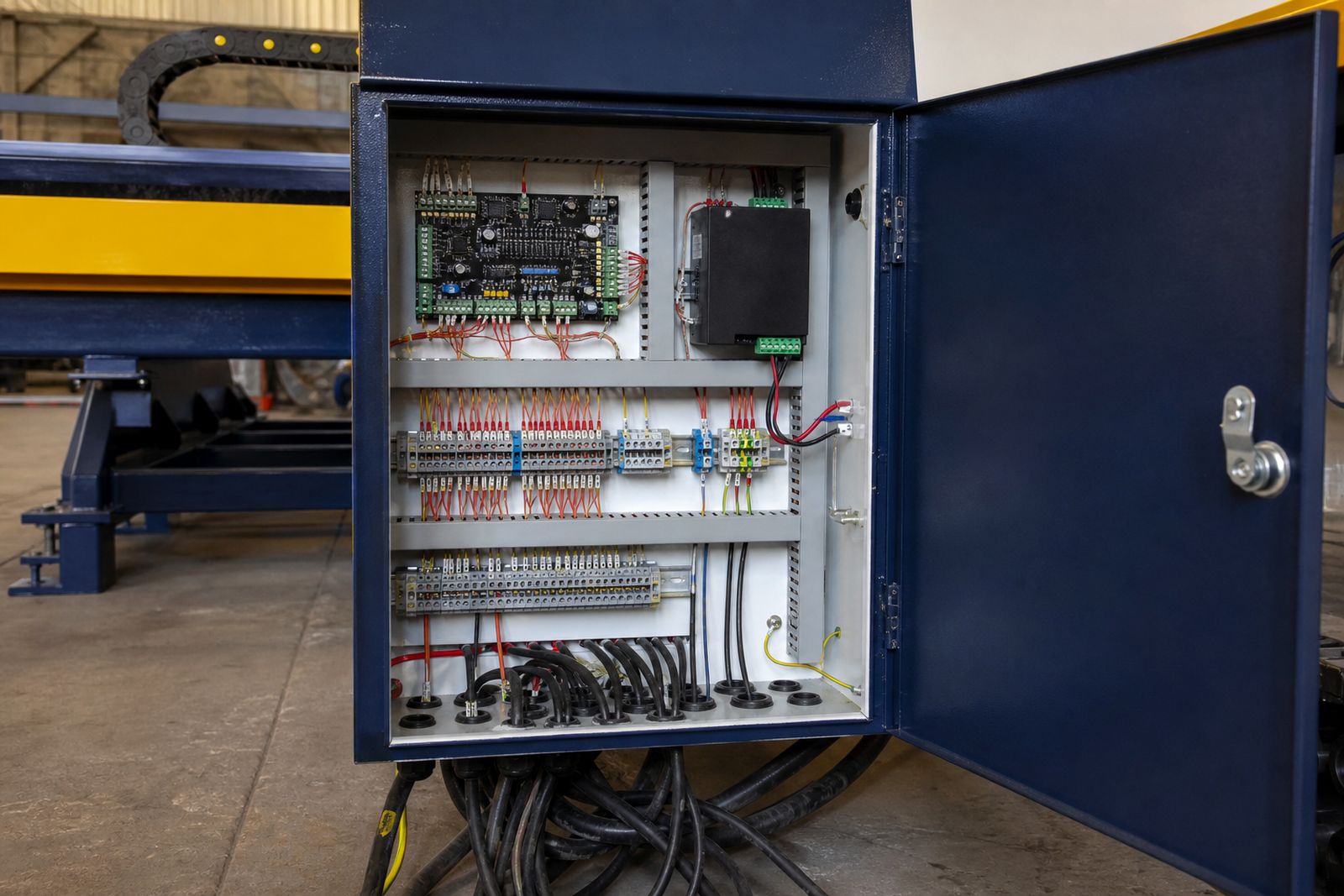
P-BOARD refers to the electronic boards that handle axis motion, home and limit inputs, torch on-off signals, height-control handover and the output channels used by the machine during cutting. On a standard-bed plasma machine these boards sit in the control cabinet and form the link between the operator controls, the drive system and the cutting process. If the cabinet wiring is tidy but the board layout is poorly matched to the machine, faults often show up as missed inputs, unstable jogging or odd start-stop behaviour.
On our standard-bed builds, the board set is chosen to match the bed size, the height-control arrangement and the options fitted to that machine. That matters because a 1 300 x 2 500 mm table with a basic cutting setup does not always need the same I/O count or expansion path as a 2 000 x 3 000 mm machine carrying more functions. The board set forms part of the build specification from the start.
- Motion signal handling for X, Y and Z movement.
- Input channels for home switches, limits and operator controls.
- Output channels for torch start, auxiliary functions and status signals.
- Board pairing matched to the chosen height-control option.
When this option is worth paying for
P-BOARD is worth close attention when the machine will cut most days, when downtime on the floor is expensive, or when the operator needs consistent behaviour between jobs. It is also important where a buyer wants a spare board set kept on hand. In many fabrication shops the lost cutting time from a failed control board costs more than the board itself, especially when plate has already been loaded and drawings are queued.
It is also sensible to specify this properly when the machine includes P-THC, P-THC/ARC, P-THC/MEC, P-REMOTE or P-FLAME. Each of those options adds signal paths or control states that must be handled cleanly. A machine can look similar from the outside while the cabinet requirements differ quite a bit inside.
- Useful for production shops cutting week after week.
- Important where a spare-board strategy is part of maintenance planning.
- Recommended when several control options are fitted together.
- Worth it when the machine may later need board replacement with minimal rewiring.
How the board set is fitted and commissioned
The boards are mounted in the control cabinet on dedicated fixings with wiring routed and labelled for service access. During assembly, power distribution, signal separation and earthing are laid out to suit the machine cabinet rather than packed in wherever space is left. That helps reduce electrical noise issues that can affect control signals around plasma equipment.
At commissioning on the customer’s floor, the board set is checked as part of homing, jogging, dry-run travel and live-cut verification. Inputs and outputs are tested against the machine functions that are actually fitted. If a spare board set is ordered with the machine, it is supplied to match the installed configuration so the workshop is not left with mismatched parts later on.
Operator training covers the practical side as well: what normal control behaviour looks like, which cabinet indicators matter during a fault, and when the operator should stop the machine rather than keep trying to restart a cut. That small bit of training saves a lot of confusion on busy shop floors.
Compatibility with bed sizes and other options
P-BOARD is available across our three standard bed sizes: 1.3 x 2.5 m, 1.5 x 3.0 m and 2.0 x 3.0 m. The required board arrangement is tied to the machine build and option code, so compatibility is confirmed at order stage rather than guessed after the cabinet is wired. P-BOARD is specified for our standard-bed CNC plasma machines and their option codes only.
Board choice must also line up with the machine’s control method and option pack. Height control, flame cutting and remote operation each place different demands on the cabinet I/O, and those demands need to be planned together.
- Compatible with P-1325T, P-1530T and P-2030T machines.
- Specified together with P-THC, P-THC/ARC or P-THC/MEC where fitted.
- Can be configured alongside P-FLAME, P-REMOTE and P-CONTROL.
- Specified for standard-bed CNC plasma machines only, excluding portable cutters, 3 m plus gantries, pre-owned machines and retrofits of other makes.
Mistakes that cause trouble later
The most common mistake is treating control boards as if any similar-looking unit will do the same job. Board matching is about signal type, channel count, wiring layout and the exact machine functions required. Another frequent problem is ordering a spare without matching it to the as-built option code. That can leave a shop with a part on the shelf that still needs rewiring or parameter changes before it can be used, which defeats the point of keeping a spare.
We also see confusion between a board fault and a setup fault. A machine that loses position, fails to home or behaves oddly on torch start may have a wiring, noise or settings issue rather than a dead board. That is why the cabinet layout, grounding and commissioning checks matter so much. Saving a little on the wrong board plan often becomes expensive later, and it makes fault-finding messier than it needs to be.
Specification points used on a standard-bed build
The exact board set depends on the machine and options ordered, but the specification is always tied back to the standard-bed build rather than left open-ended. For most buyers the useful questions are straightforward: how many controlled axes are involved, how many input and output channels are required, how the height-control interface is handled and whether a matching spare should be supplied with the machine.
If you are comparing builds, send the machine model and option codes through our contact form so the cabinet board arrangement can be matched properly. That keeps the discussion on the machine that will actually be delivered, not a standard parts list.
- Installed in the machine control cabinet.
- Configured to suit the ordered bed size and option code set.
- Supports machine motion, control inputs and switched outputs.
- Available with matching spare-board provision at order stage.
What our CNC Plasma Machine customers say
Verified Google reviews
Questions we get asked
Can I order P-BOARD on its own for another machine?
P-BOARD is specified for our standard-bed CNC plasma machines and their option codes. We do not supply it as a retrofit package for other makes.
Do I need a spare board set from the start?
If the machine will be used heavily or downtime is costly, a matched spare board set is often worthwhile. It should be ordered against the machine’s final build specification.
Does P-BOARD change the cutting size of the machine?
Bed size is set by the machine model. P-BOARD affects control and signal handling inside the cabinet, not the physical cutting area.
Also worth a look
Tell us about the job
Send sizes, materials and where you are through our contact form, and we will come back with the practical options.
Open the contact form